 +60520 fans
Your cart is empty









About Filigree
The Art of Filigree Through the Ages
The origins of filigree go back to the third millennium BC, in Mesopotamia. The oldest pieces date from 2500 BC and were discovered in the tombs of Ur, in present-day Iraq. Other pieces, found in Syria, date from around 2100 BC.
Filigree reached Europe along the Mediterranean trade routes and became fairly popular in the Greek and Roman civilizations. The oldest filigree jewelry found in Europe was discovered in present-day Italy and is thought to date from the 18th century BC. The word “filigree” itself was born during the Roman Empire.
But because the Middle East was a crossroads of cultures, filigree kept traveling and crossed borders all the way to India and China. In the Far East it was used mainly for decoration rather than jewelry — we find, for example, filigree-covered sculptures, teapots, plates and boxes.
Of course, filigree from such a distant past was not the same as the filigree we know today: the patterns were different, and so was its use. But the similarity of the techniques leaves no room for doubt — we can identify these ancient pieces as true examples of filigree.
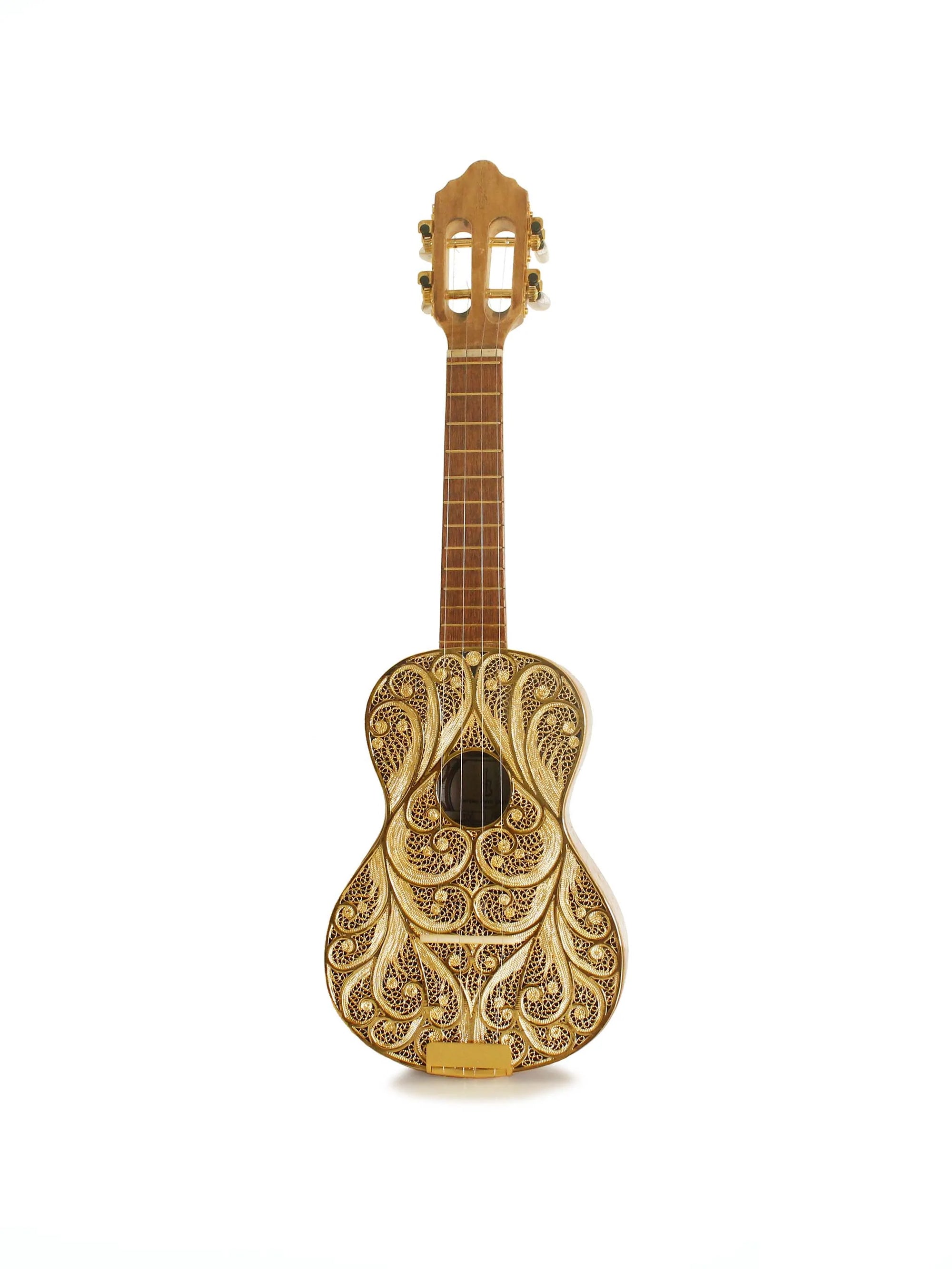
So what makes filigree different? Simple: the way many fine threads trace patterns and are soldered together to create a much larger piece. No other jewelry art uses a similar fusion technique to join threads of gold. Today — just as thousands of years ago — the threads that make up each piece are joined by heat alone, without any other material or alloy.
We can also say that no other goldsmithing technique uses so little metal to create shapes so large and so extraordinary. In some filigree hearts, for example, half the “surface” of the piece can be air!
Filigree in the Iberian Peninsula
The oldest filigree pieces discovered in the Iberian Peninsula date from 2000–2500 BC, but their origin is unclear. They probably belonged to merchants or seafarers from the Middle East and were not made here.
Mining in the Peninsula only began under Roman rule, in the 2nd century BC — as a curiosity, this was when the mines of the Pia and Banja hills in Gondomar were first worked.
But only many centuries later, in the 8th century AD, can we say for certain that filigree was being developed and produced in Portugal. It was with the arrival of the Arab peoples that new patterns appeared and that, little by little, Iberian filigree began to set itself apart from filigree elsewhere in the world.
While the filigree tradition faded in neighboring Spain, in Portugal it was refined. By the 17th century, Portuguese filigree already had its own imagery and forms quite unlike any other filigree.

The Shapes and Styles of Portuguese Filigree
Portuguese filigree mostly depicts nature, faith and love:
- the sea appears as fish, shells, waves and boats;
- nature inspires the flowers, clovers and garlands;
- among the religious motifs arecrosses, such as the Maltese cross, and reliquaries — and, more recently, medallions with saints,angels andreligious figures;
- and love, of course, inspires every one of ourfiligreehearts.
Other iconic symbols of our filigree have historical origins, or origins that are not entirely clear. We are talking about:
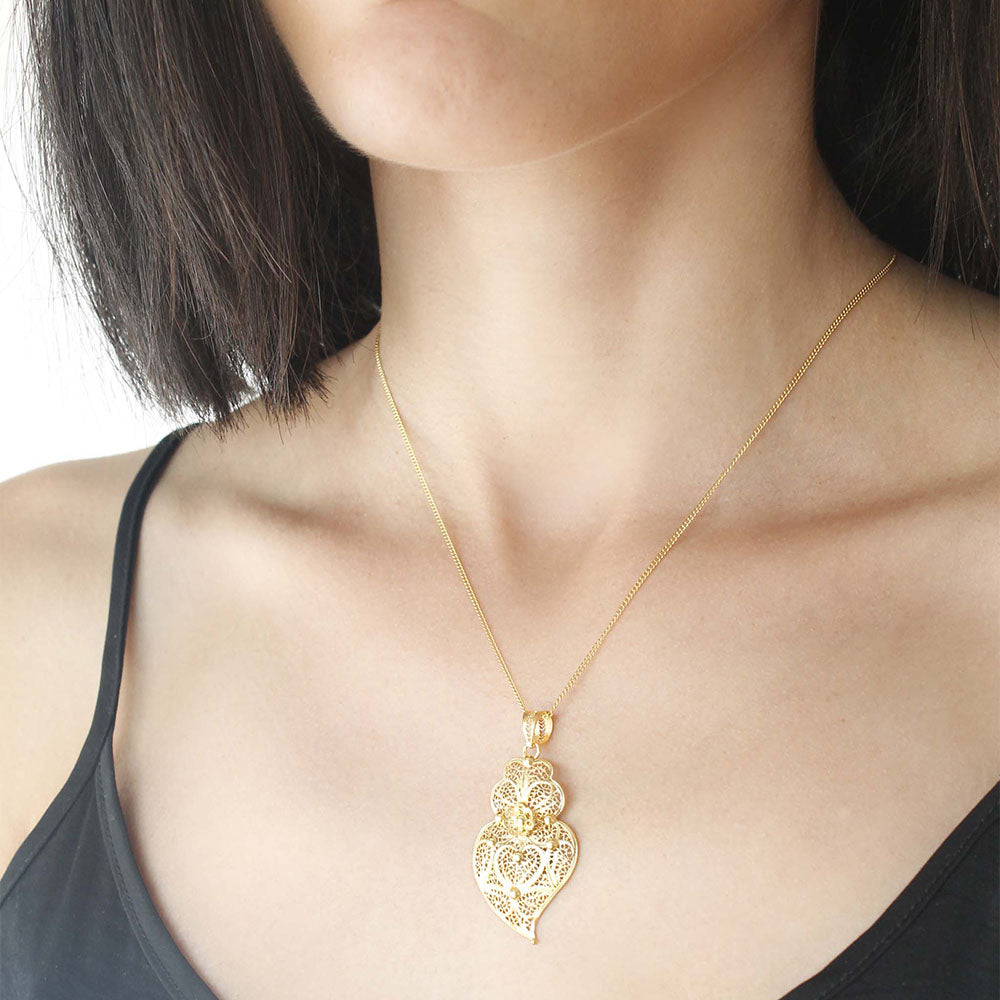
The Viana Heart
Contrary to what you might think, the Viana Heart was not first meant as a symbol of love, but as a symbol of devotion to the Sacred Heart of Jesus. It is said that Queen Maria I, grateful for the “blessing” of a male heir, commissioned a heart made of gold.
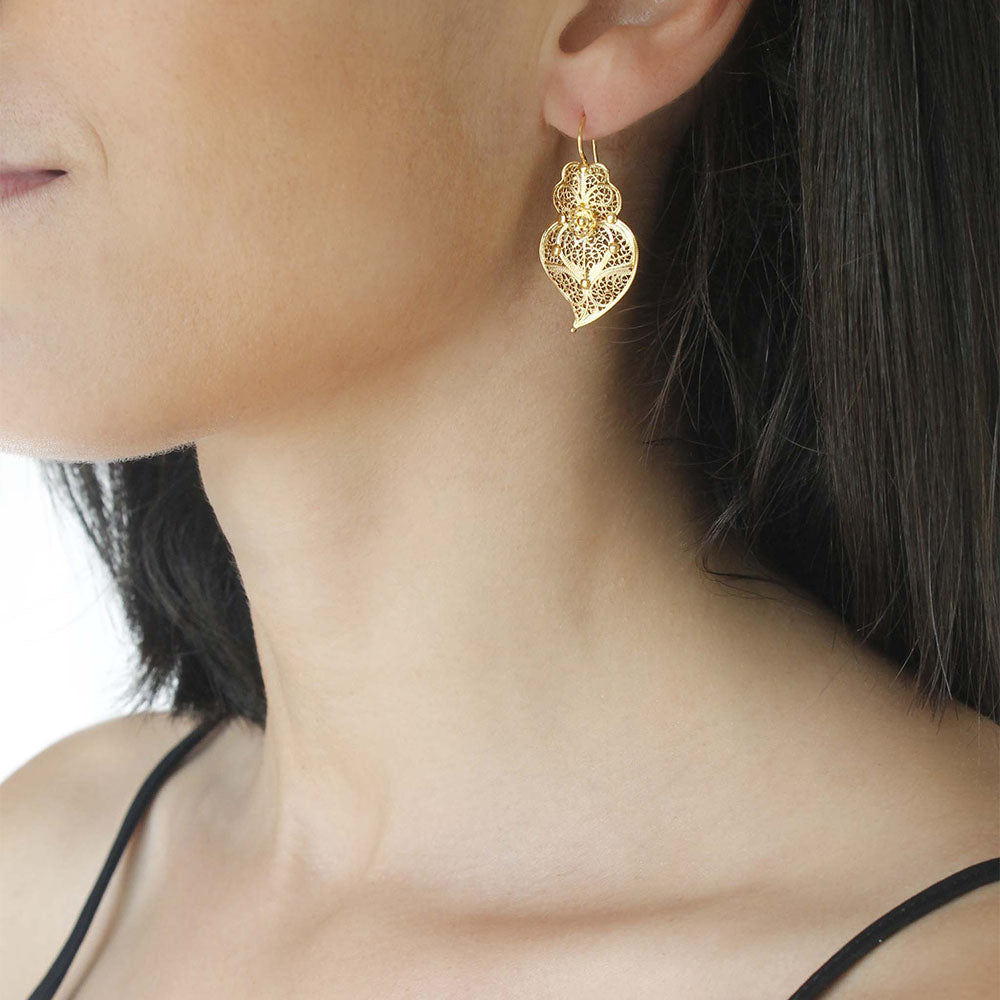
Queen Earrings
It is almost universally agreed that Queen Earrings appeared in Portugal during the reign of Queen Maria I (1734–1816). The name, however, seems to date from the reign of Queen Maria II (1819–1853), who wore a pair on a visit to Viana do Castelo in 1852. After that visit they became popular as a symbol of wealth and statusand took the name “brincos rainha” (queen earrings). In other parts of the Minho region they are still known as “in the queen's style”, “noblewoman's earrings” or “rich woman's earrings”. But what is truly fascinating is the design of theQueen Earrings. They are said to symbolize female fertility: a round section with a smaller circle joined to the main piece by a seemingly delicate link — a symbol of the child's bond to the mother's womb, from which it will one day be released. Followers of this theory also point out that the lower part of the earring is an inverted triangle, already a feminine symbol at the time.Arrecadas
Arrecada earrings began as the earrings of ordinary people, and were later imitated by the wealthier classes. They descend from the Castro-culture arrecadas, inspired by the crescent moon.
Bead Necklaces
Bead necklacesare as old as the goldsmith's art itself. Viana beads descend from Greek beads: they are hollow, which makes them light, and perfectly round. What sets them apart is their filigree thread and a small dot at the center. They came about because a whole filigree necklace was hard to afford: women would buy one bead at a time until they had a full strand. It also meant the necklace could be changed and made exactly the length they wanted.
Portuguese Filigree Today
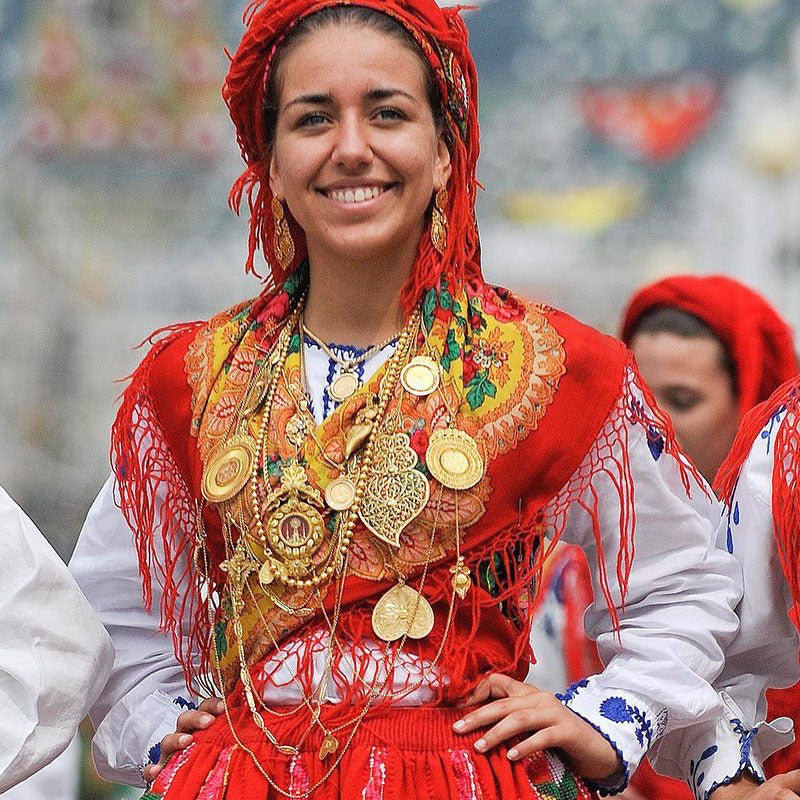
Today, filigree in Portugal is made mainly around Gondomar and Póvoa de Lanhoso. In the Minho region, filigree is still tied to a long-standing tradition: the “Sunday best” costumes. The traditional women's costume of the Minho is always finished with several pieces of gold, including necklaces and earrings passed down from generation to generation.
Fully Handmade Filigree
Unfortunately, we cannot guarantee that our pieces are fully handmade: there are not enough filigree fillers (enchedeiras) in the whole country to keep up with orders. But we won't mislead anyone — any piece that is fully handmade will say so clearly in its description.
We want fully handmade filigree to survive, and we will do everything we can to help it carry on.